Off Grid Planning Tool
The open-source Offgridplanner tool is designed to perform a spatial optimization of distribution grids, it analyses whether consumers are best connected to a mini-grid or electrified through a solar home system, while simultaneously optimizing the energy system components to determine the most viable option for providing access to energy at a specific location.
The features of the tool are listed below:
- Automatic identification of buildings from OpenStreetMap
- Spatial optimization of the distribution grid
- Design optimization of the generation systems (PV systems, battery systems, inverters, hydrogen components and diesel-engines)
- Automatic identification of buildings that are better to be served by individual solar home systems.
The tool can be tested without registration. However, users are recommended to create an account to get access to larger computing capacity and to be able to store models.

Map-based Consumer Selection
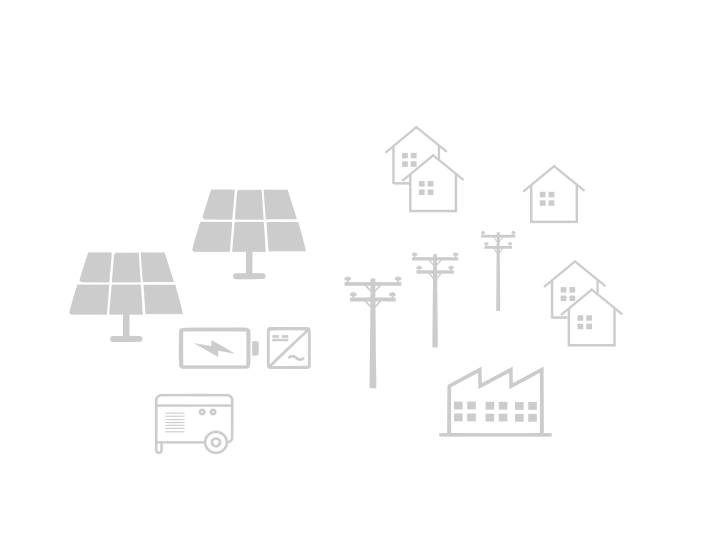
For the spatial optimization of the electric grid, the geolocation of the consumers must be provided. For this, a map from OpenStreetMap is integrated into the tool. The determination of the geocoordinates of the consumers can be done in three ways:
Automatic detection of buildings within areas marked using drawing tools.
Manual selection of consumer locations by placing markers on the map.
Manual input of the geocoordinates using input fields.
Demand Estimation
The tool provides standard load profiles for different consumer types—such as households, public buildings, enterprises, and specific high-load appliances that users can select. These demand profiles are based on Thailand-specific data gathered throughout the Green-H2-Islands project, as well as previous research on island electrification in Thailand. The aim is to offer a low-barrier modelling experience by using basic information about site-specific demand behaviour. If more detailed data is available, users can also upload their own load profiles and use them directly within the tool.

Spatial Optimization of the Distribution Grid
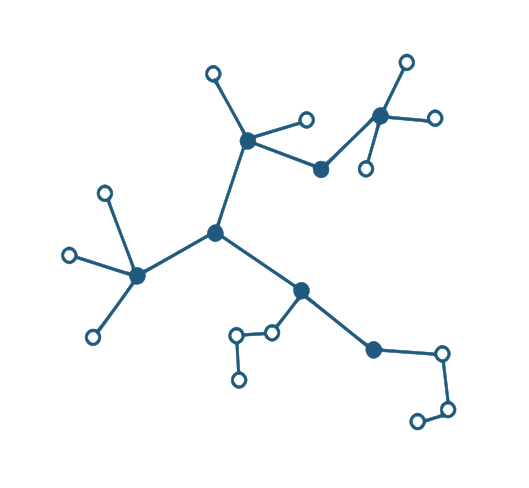
The spatial grid optimization tool operates through a sequence of steps that ensure efficient energy system design. The tool identifies consumers, sorts them based on proximity to the load center, and meticulously calculates the optimal setup required to connect all consumers within the grid, adhering to constraints on maximum connections per consumer and maximum distance between consumers. The tool employs a clustering algorithm to determine optimal pole locations, constructs a minimum spanning tree (MST) for efficient pole interconnectivity, and connects each consumer to their nearest pole. If needed, the number of poles is increased, ensuring all constraints are met. Furthermore, long links exceeding the maximum allowed distance are segmented into smaller ones with additional poles. Thus, the tool offers a comprehensive solution for optimal grid design.
Design Optimization of the Generation System
This tool excels in the design and optimization of off-grid energy systems, integrating different types of energy converters including photovoltaic (PV) systems and diesel generators, along with components like battery systems, inverters, and rectifiers. The tool uses ERA5 satellite data and PVLIB for the modeling of solar potentials in PV systems. The design optimization of the tool revolves around minimizing the Levelized Cost of Energy (LCOE), a method that considers both capital and operational costs. This results in an optimal configuration that satisfies consumer demands, modeled as a mixed-integer linear model. Leveraging the open-source modeling framework OEMOF and a high-efficiency MILP solver, the tool offers an effective solution for complex optimization challenges. The insights generated by the tool - including installed capacities, time series of system operations, investment costs, CO2 emissions, and fuel requirements - provide stakeholders with invaluable information for strategic decision-making.

About
The Green H2Islands project (FKZ: 67EXI7501A) is funded by the Federal Ministry for the Environment, Climate Action, Nature Conservation and Nuclear Safety (BMUKN) as part of the “Export Initiative Environmental Protection” (EXI). As the EXI project management agency, Zukunft – Umwelt – Gesellschaft (ZUG) gGmbH supports the Federal Ministry for the Environment in carrying out its tasks. As a project of the thematic focus “green hydrogen and fuel cell technologies for decentralized energy supply” within the Export Initiative Environmental Protection, NOW GmbH supports the Green H2Islands project in its function as a program company.